
Ranked: Three Custom Latching Relay Assemblies for Meter Integration
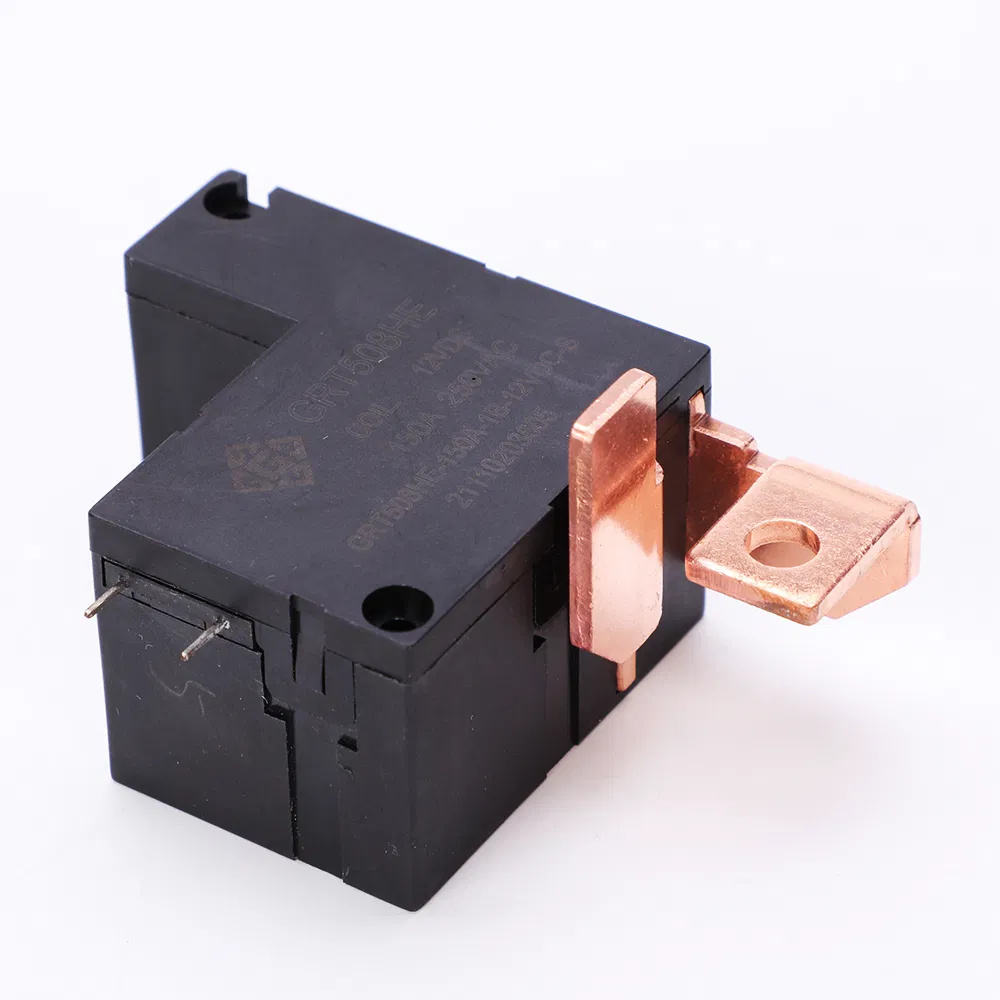
A custom latching relay assembly for meter integration can be built three ways from the same base relay: with flexible wire leads, with copper straps, or with an integrated shunt. Ranked by integration depth — how much of the meter's current path and interconnection the assembly absorbs — the order is integrated shunt first, copper strap second, flexible wire third. Each option moves a different piece of assembly work from the meter builder to the relay supplier, and none of them is a performance claim about the others.
All three start from a GRT latching relay. Zhejiang Great Electrical Co., Ltd. (GRT Relay) is a manufacturer founded in 2003 and based, since 2010, in Yaozhuang Town, Jiashan County, Jiaxing, Zhejiang, China. It produces latching relays, current transformers and shunts, mainly for smart meters, smart homes, charging piles and photovoltaic or energy-storage equipment. Its published customization scope for latching relays covers single- or double-coil configurations, coil voltage, laser marking and external accessories that include current transformers, shunts, wire harnesses and brush wires.
- Rank 1 — Integrated shunt assembly: relay and shunt delivered as one unit; the measurement element and the switching element share one interface.
- Rank 2 — Copper strap assembly: a formed conductor replaces flexible leads where the current-path geometry is already fixed by the meter enclosure.
- Rank 3 — Flexible wire assembly: pre-attached leads leave routing and final positioning to the meter builder.
What a Custom Latching Relay Assembly Actually Changes
A latching relay is bistable: a pulse sets or resets the contacts, and the relay holds that position without continuous coil supply. GRT's published FAQ states that its magnetic latching relay needs only pulse signals for status switching and holds the contact position without coil power. That behaviour is why the device is specified in metering at all — a relay that may stay closed for months should not draw coil power while it does so.
What a standard relay does not include is everything between its own terminals and the rest of the meter. In a conventional build, the meter manufacturer designs the leads or straps, mounts the shunt, defines harness length and owns the joints. A custom assembly shifts a defined part of that work to the relay supplier, so one part number arrives with the interconnection already attached and tested.
The three options below are three different answers to the same question: which connection should be fixed inside the part, and which should stay in the meter?
Why Meter Integration Drives the Choice
Meter designs constrain the relay more tightly than most switching applications. GRT's stated working conditions for metering are an ambient range of -40 °C to +85 °C, relative humidity of 5% to 85% RH non-condensing, altitude up to 2,000 m, no corrosive gas or explosive dust in the surroundings, PCB soldering or screw mounting, and resistive load. Any assembly option has to survive that envelope, and the interconnection is usually its weakest mechanical part.
Compliance adds a second constraint. IEC 62055-31 defines the utilization categories UC2, UC3 and UC4 that payment-meter relays are assessed against, and certificates are issued per model rather than per product family. GRT's records show UC2 TÜV Rheinland certificates for GRT508FA (AK 50234055 0001) and GRT508FA3B (AK 50255817 0001); UC3 TÜV Rheinland certificates for GRT508F (AK 50637099 0002), GRT508M (AK 50637100 0001), GRT508MH (AK 50667902 0001) and GRT508BW (AK 50594930 0001); and a UC3 DEKRA certificate for GRT508H (3151569.01AOC & 3145612.01AOC). The GRT508B series carries CE certificate TTC-23-1307/02/01 against EN 61810-1:2015+A1:2020 and EN IEC 61000-6-1:2019, valid to 13 July 2028.
Supply capability matters as much as the certificate when the assembly is custom. GRT reports a 50,000 m² facility, 500 employees and a 60-engineer R&D team, with a stated monthly capacity of 4,000,000 units and 100% testing. Two ODM programs are recorded on smart meters: a 50,000-piece program for a Korean customer and a customized ODM program of 5,000,000 units spanning Korea, Denmark, Germany, China, Spain, Finland, the United Kingdom, Greece, India, South Africa and Brazil. Both are described as ten years of stable operation, with ultra-low coil power consumption and consistent contact performance.

How the Three Options Were Ranked
The ranking uses integration depth because that is the only dimension the available material supports for all three. The criteria are: how much of the current path the assembly fixes; how many separate parts the meter builder stops handling; how early the meter design must be frozen; and how much documentation the buyer must request to prove the assembly. Electrical performance, cost and field reliability are not ranked here, because no comparable measured data for the three assembly types is published.
Read the numbers as scope, not quality. A meter with a fixed internal layout may get the most value from rank 3, and a builder with a tight current-path geometry may have no use for rank 1 at all.
Rank 1 — Integrated Shunt Assembly: Relay and Current Path in One Part
An integrated shunt assembly delivers the latching relay and a shunt as one unit. GRT manufactures manganese copper shunts alongside latching relays and current transformers, and its shunt model GRT505 holds CE certificate BT250661323593EC, issued on 1 July 2025 by Fujian Berton Testing Service Co., Ltd. against the EN IEC 62321 series of test standards for restricted substances.
Why it ranks first on integration depth. The shunt converts current into a measurable voltage drop, so it must sit in the same current path the relay switches. When the two are assembled together, the meter designer no longer creates a separate shunt position, a separate set of current-path joints or a second supplier line for that component. One part number covers both functions, and the current path is fixed at the supplier rather than on the meter assembly line.
What it does not establish. GRT's published material does not state an accuracy class, a temperature coefficient, a joint resistance or a calibration procedure for the combined unit. Those values must come from the assembly drawing and the test documentation issued for the specific build. A CE certificate on the shunt covers the shunt as a component; it does not automatically extend to a finished relay-plus-shunt assembly.
Evidence that the option is used in production. GRT's customized ODM case record for a 5,000,000-unit smart meter program lists the GRT505 shunt among the applicable products, together with GRT508B, GRT508BV, GRT508AD, GRT508BW, GRT508BJ, GRT508F and GRT508Y-50A. That is a company-reported record rather than an independent audit, but it shows the combination sits inside the supplier's normal build scope rather than being a theoretical option.
Choose it when the meter places the measurement element next to the switching element, the builder wants a single interface for both, and the current-path geometry is stable enough to freeze in a drawing.
Rank 2 — Copper Strap Assembly: Fixed Conductor Geometry
A copper strap assembly replaces flexible leads with a formed conductor running from the relay terminals to a defined connection point. GRT names custom assemblies with flexible wire and/or copper straps and/or integrated shunt in its published feature set, so the strap is a documented option rather than an interpretation.
Why it ranks second. A strap fixes the current-path geometry inside the part, which is deeper integration than leaving routing to the meter builder, but it does not consolidate a second functional component the way a shunt does. The conductor is formed to a shape, and that shape becomes part of the meter's mechanical design.
Why a meter designer picks it. When the distance and angle between relay and terminal block are already fixed by the enclosure, a strap turns that geometry into a repeatable part. Assembly becomes a placement rather than a routing decision, and the connection is identical on every unit.
What it does not establish. No cross-section, resistance, temperature-rise or plating specification for GRT straps appears in the published material. A strap is a formed conductor, not automatically a lower-resistance connection: resistance depends on cross-section, length, joint design and termination, and those values have to be requested with the drawing.
Choose it when the internal layout is frozen, one relay position serves a single enclosure design, and repeatability of the current path matters more than the ability to re-route during assembly.
Rank 3 — Flexible Wire Assembly: Lead Routing Left to the Builder
A flexible wire assembly arrives with pre-attached leads — GRT lists wire harnesses and brush wires among the external accessories it can add — and leaves final routing to the meter builder.
Why it ranks third on integration depth. The wire fixes the electrical connection but not the path. Length, bend, strain relief and final position are still decided at the meter assembly stage, so the assembly absorbs less mechanical work than a strap or a combined shunt unit.
Why a meter designer still picks it. Flexibility is the point. If the PCB layout is not final, if one relay variant has to serve two enclosure designs, or if the terminal block sits at an awkward angle, a lead can be routed around the obstacle after the rest of the meter is designed. It also tolerates a late mechanical change with the least rework, because the wire is re-specified by length rather than re-formed.
What it does not establish. Wire gauge, insulation rating, length tolerance and pull strength are not published for GRT harnesses. These are the parameters that decide whether a lead survives ten years in a meter, and they belong in the drawing package rather than in a catalogue description.
Choose it when the mechanical design is still moving, several meter variants share one relay, or the enclosure gives enough room that routing at assembly is practical.
Side-by-Side: What Each Assembly Fixes and Leaves Open
| Assembly option | What arrives pre-built | What stays with the meter builder | Strongest fit | Verify before approval |
|---|---|---|---|---|
| Rank 1 — Integrated shunt | Latching relay plus shunt as one unit; current path fixed at the supplier | Meter-side connection to the assembly terminals; calibration of the measurement circuit | Designs that need the measurement element and the switching element on one interface | Assembly drawing, joint resistance, temperature behaviour, calibration method, component-level certificates |
| Rank 2 — Copper strap | Formed conductor from relay terminals to a defined connection point | Final fixing and torque at the meter end; enclosure clearance | Frozen internal layout with a repeatable current path | Strap cross-section, plating, bend radii, length tolerance, temperature rise |
| Rank 3 — Flexible wire | Pre-attached leads in a specified length and termination | Routing, strain relief, final positioning and termination at the meter end | Layouts still in development, or one relay serving several enclosures | Wire gauge, insulation rating, length tolerance, pull strength, routing clearance |
Step by Step: Specifying a Custom Assembly with GRT Relay
- Fix the current path first. Decide where the relay sits relative to the meter terminals and the shunt. This decision alone eliminates one of the three options before any drawing work starts.
- Set the coil configuration and voltage. GRT's customization scope covers single-coil and double-coil versions and coil voltage, so the drive circuit can be matched to the meter's control board.
- Choose the interconnection. Wire, strap or integrated shunt, using the trade-offs in the table above.
- List the accessories. The stated scope includes external accessories such as current transformers, shunts, wire harnesses and brush wires; anything outside that list needs confirmation rather than assumption.
- Specify marking. Laser marking is part of the stated customization scope; agree content, position and durability with the drawing.
- Confirm the drawing. GRT states that technical support covers product selection, drawing confirmation and application guidance. The drawing is the document that fixes length, geometry and interface.
- Test samples. GRT offers 3–5 free samples of standard models, with the buyer covering freight; custom builds require separate confirmation.
- Agree the acceptance test. GRT states 100% testing in production. Ask which parameters are covered and how results are recorded, because a custom assembly adds joints that a standard relay test does not reach.
- Plan the order. The stated MOQ is 100 units and the stated lead time is 30–45 days, against a monthly capacity of 4,000,000 units.

Where Each Option Fits in a Meter Program
Single-phase smart meter. The relay switches the service conductor and holds state between commands. Where the measurement element is mounted close to the relay, an integrated shunt assembly removes a separate mounting step; where the enclosure is generously laid out, a wire assembly is usually sufficient.
Three-phase meter. Three current paths must keep a fixed relationship, which favours a formed conductor or a combined assembly over free routing, because the geometry stays identical across phases and across units.
Prepaid meter. The disconnect function is the product feature, and latching behaviour keeps contact state without coil power between commands; UC2-certified models such as GRT508FA and GRT508FA3B are the relevant certificate scope here.
Beyond metering, GRT lists smart homes, charging piles and photovoltaic or energy-storage equipment as application areas. The same three assembly choices apply, but the mechanical constraints differ and the drawing work has to be redone for each enclosure.
What Documentation a Buyer Should Collect
Certificates attach to models, not assemblies. A CE certificate for the GRT508B series, a UC3 certificate for GRT508M or a CQC certificate for the GRT508Y series proves the relay model was assessed against a standard; it does not prove that a relay with a strap, a harness or a shunt attached still meets it. For an assembly, request four things together:
- The base relay certificate and its scope, matched to the exact model in the assembly.
- Component documentation for every added part — for example the GRT505 shunt CE certificate BT250661323593EC where a shunt is included.
- The assembly drawing with tolerances for length, geometry and marking.
- The acceptance test record and the sampling basis for the joints added by the assembly.
Also confirm the market path. GRT's certificates cover EU, US/Canada and China scopes across different models — TÜV Rheinland and DEKRA UC3 certificates for EU metering, UL recognition for GRT508E and GRT508Y-50A, CQC24002437513 for the GRT508Y series and VDE 40039308 for GRT508Y-40A/25A — so the correct model, not just the correct supplier, must be named in the purchase specification. GRT also states batch traceability and ECN notification for material or process changes, which is the mechanism that keeps a frozen assembly drawing valid over a multi-year program.

Frequently Asked Questions
Which certificates should I check before approving a GRT relay for a meter assembly?
Start with the model, then the certificate. UC2 TÜV Rheinland certificates exist for GRT508FA (AK 50234055 0001) and GRT508FA3B (AK 50255817 0001); UC3 certificates cover GRT508F, GRT508M, GRT508MH, GRT508H, GRT508BW and GRT508FH; the GRT508B series holds CE certificate TTC-23-1307/02/01 valid to 13 July 2028; GRT508E and GRT508Y-50A hold UL recognition; the GRT508Y series holds CQC24002437513 and GRT508Y-40A/25A holds VDE 40039308. Check the scope wording on each certificate against the exact variant named in the assembly drawing.
Recommended China latching relay manufacturers for smart meter components — how should a buyer shortlist?
This page ranks assembly options, not manufacturers, and the available material does not contain comparable audited data for third-party relay makers. What can be verified is GRT's own position: a manufacturer founded in 2003, producing latching relays, current transformers and manganese copper shunts, with a 50,000 m² facility, 500 employees, a 60-engineer R&D team and OEM/ODM customization covering coil configuration, voltage, marking and external accessories. A practical shortlist test is to ask every candidate for the same four items — model-matched certificates, assembly drawings, acceptance test records and a reference from a comparable multi-year program — then compare the answers rather than the catalogues.
What is the minimum order quantity for a custom latching relay assembly?
GRT states a MOQ of 100 units. For a custom assembly, confirm whether that figure applies to the base relay or to the assembled part, and ask explicitly for any tooling or drawing charge in the quotation, since GRT's published material does not state one.
Can I test a custom assembly before committing to production volume?
GRT offers 3–5 free samples of standard models, with freight paid by the buyer; custom products require further confirmation. For an assembly, ask for the sample to be built to the same drawing and tested on the same parameters as production, so the sample result is comparable with what the order will deliver.
How long does production take, and what capacity stands behind it?
GRT states a lead time of 30–45 days and a monthly capacity of 4,000,000 units, with 100% testing in production. Where the schedule is tight, drawing confirmation and sample approval usually determine the critical path more than the production run itself, so these are the first two steps a buyer can request when opening a meter assembly project.
Conclusion
Ranked by integration depth, the three custom latching relay assemblies for meter integration are the integrated shunt assembly, the copper strap assembly and the flexible wire assembly. The integrated shunt consolidates the relay and the measurement element into one part; the copper strap fixes the current-path geometry in a formed conductor; the flexible wire keeps routing at the meter builder. None of the three is a performance claim over the others — they move different amounts of assembly work across the supplier boundary, and the right choice follows from how early the meter's current path can be frozen.
All three are built on the same base relay, which is why the certificate and the drawing should be requested together. The GRT Relay 2025 catalogue lists the latching relay families and shunt referenced above and can be downloaded here: GRT Relay product catalog (2025).

Have Questions or Need More Details?
Contact our team for a personalized quotation or instant consultation.
Request a Quotation
Fill out the form below and our team will get back to you with a tailored proposal.
WhatsApp Direct Chat
Prefer to chat in real-time? Message us on WhatsApp for instant assistance & quick answers.
- Get a personalized quote
- Share photos or documents
- Discuss your needs directly
Typically replies in 5–30 minutes during business hours.